
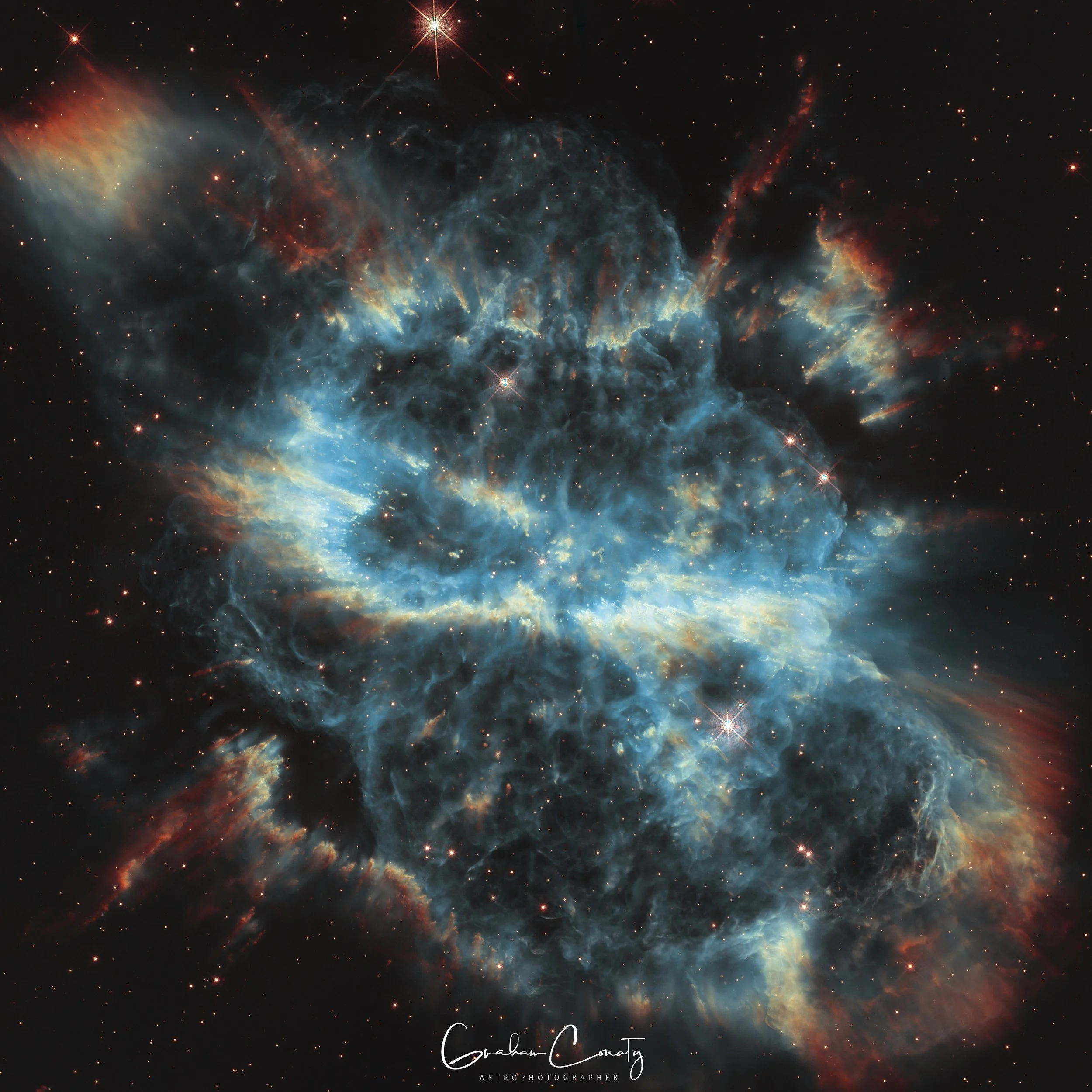
NGC5189 GRAHAM CONATY / HUBBLE LEGACY ARCHIVE
NGC 5189, also known as Gum 47 or IC 4274, is a planetary nebula in the constellation Musca at a distance of around 3,000 light-years from Earth.
It was discovered by James Dunlop on 1 July 1826.
For many years, well into the 1960s, it was thought to be a bright emission nebula. It was Karl Gordon Henize who, in 1967, first described NGC 5189 as quasi-planetary based on its spectral emissions.
Seen through the telescope it seems to have an S shape, reminiscent of a barred spiral galaxy. The S shape, together with point-symmetric knots in the nebula, have for a long time hinted to astronomers that a binary central star is present.
The Hubble Space Telescope imaging analysis showed that this S shape structure is indeed two dense low-ionization regions: one moving toward the north-east and another one moving toward the south-west of the nebula, which could be a result of a recent outburst from the central star.
Location: Hubble Space Telescope
Data Source: Hubble Legacy Archive